Created: December 2004. Updated 15 February 2010.
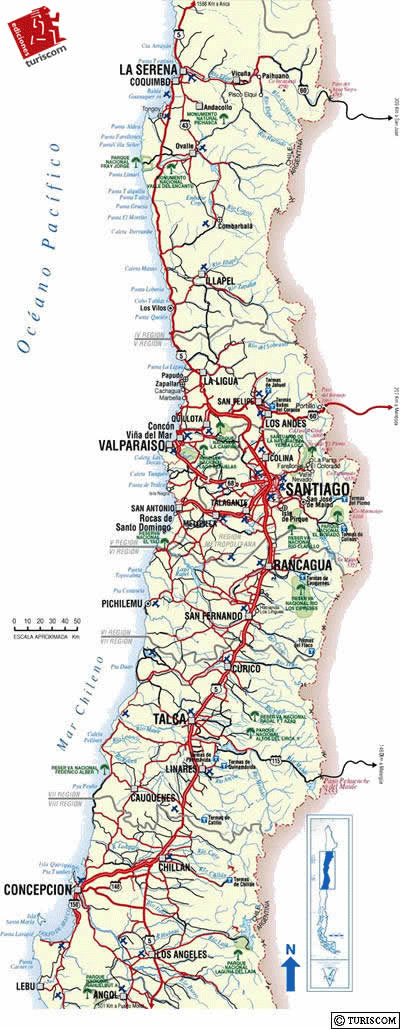
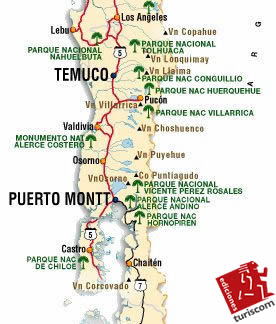
Chile is a long and narrow country on the southwest coast of South America and extends for approximately 2,800 miles (4,500 km) from north to south. It is bounded on the west by the Pacific Ocean and on the east by the Andes Mountains and the country of Argentina. Much of Chile has a Mediterranean-like climate, with an extremely dry desert in the north (Atacama) and a cold and wet landscape to the south (Tierra del Fuego - Juan Fernandez Archipelago). Santiago, the capital, has a climate similar to that of Los Angeles, California. The Lake District, near the cities of Valdivia and Puerto Montt, has a climate similar to the Pacific Northwest: lots of rain.
Continental Chile is isolated biologically on the north by the Atacama desert, to the east by the Andes, and to the south and west by oceans. This area contains diverse vegetation types, including hyperarid desert, summer-dry scrublands (chaparral), the dry cold puna of the high Andes, and temperate rainforest. The Chilean flora includes about 5,000 species of vascular plants. About 49% of the native species are estimated to be endemic to Chile; this proportion is expected for oceanic islands but unusually high for a continental area.
The photographs in the following pages were taken at four general locations in Chile: Santiago; Yerba Loca Nature Santuary in the Andes east of Santiago; in the Cochamó Valley east of Puerto Montt in the Lake District; and in Puyehue National Park, also in the Lake District. These photographs were taken between 13 and 29 December 2004.
The vascular plant flora of Chile is rich and diverse. The flora consists of approximately 5,739 taxa, of which 2,452 (42.7%) are native, and 2,630 (45.8%) are endemic to Chile. Only 657 taxa are naturalized species, representing only 11.4% of the flora. Compared to California, there is a higher percentage of endemism and a lower percentage of invasive exotics in Chile. I would account for this primarily to the high percentage of the land is rugged terrain and is has a much smaller population who are only now starting to alter the natural landscape by development (urbanization, agricultural expansion, logging, and hydroelectric). Chile has an unusually high number of monotypic species, at 496. This says that there is a high rate of speciation, and the genus level. I don’t know how that compares to California, but California is probably not too far behind Chile in this respect.
There are 116 species of ferns in Chile, which is quite rich. 11.2% of the ferns are endemic. In California, there are about 80 taxa. On the other hand, there are only 10 species of gymnosperms, in 4 families: the Araucariaceae, Cupressaceae, Ephedraceae, and Podocarpaceae. There are many more gymnosperm species in California, with 58 species in 5 families: Cupressaceae, Ephedraceae, Pinaceae, Taxaceae, and Taxodiaceae.
Of the 3,906 species of dicots in Chile, 43.7% are endemic. Of the 1,069 species of monocots, 32.3% are endemic to Chile, which is quite high. For a partial comparision, California's California Floristic Province (which includes most of California [excluding the deserts] and a small part of southwestern Oregon and northern Baja California, Mexico) has (as calculated in 1978 by Raven and Axelrod) 2,124 endemic species representing 47.7% of the province's flora.
As is for California, the Asteraceae is the largest family in Chile, with 1,033 taxa, representing 18% of the Chilean flora. The genus Senecio has the greatest number of taxa, at 252. California has only 47 taxa, of which 6 are naturalized, depauperate compared to Chile! Fortunately, none of the invasive Senecio species in California come from Chile.
Chile is rich in the genus Viola, with 100 species. California has approximately 31 Viola taxa, of which 2 are not native.
A checklist of the complete Chilean flora was published by Marticorena and Quezada in 1985. They are botany professors from the University of Conception, Chile.
Below are links to several webpages focusing on specific of areas of Chile visited in December 2004, featuring photographs of the Chilean landscape and a number of the plants in those areas.
Santiago Photos 1